Episode Transcript
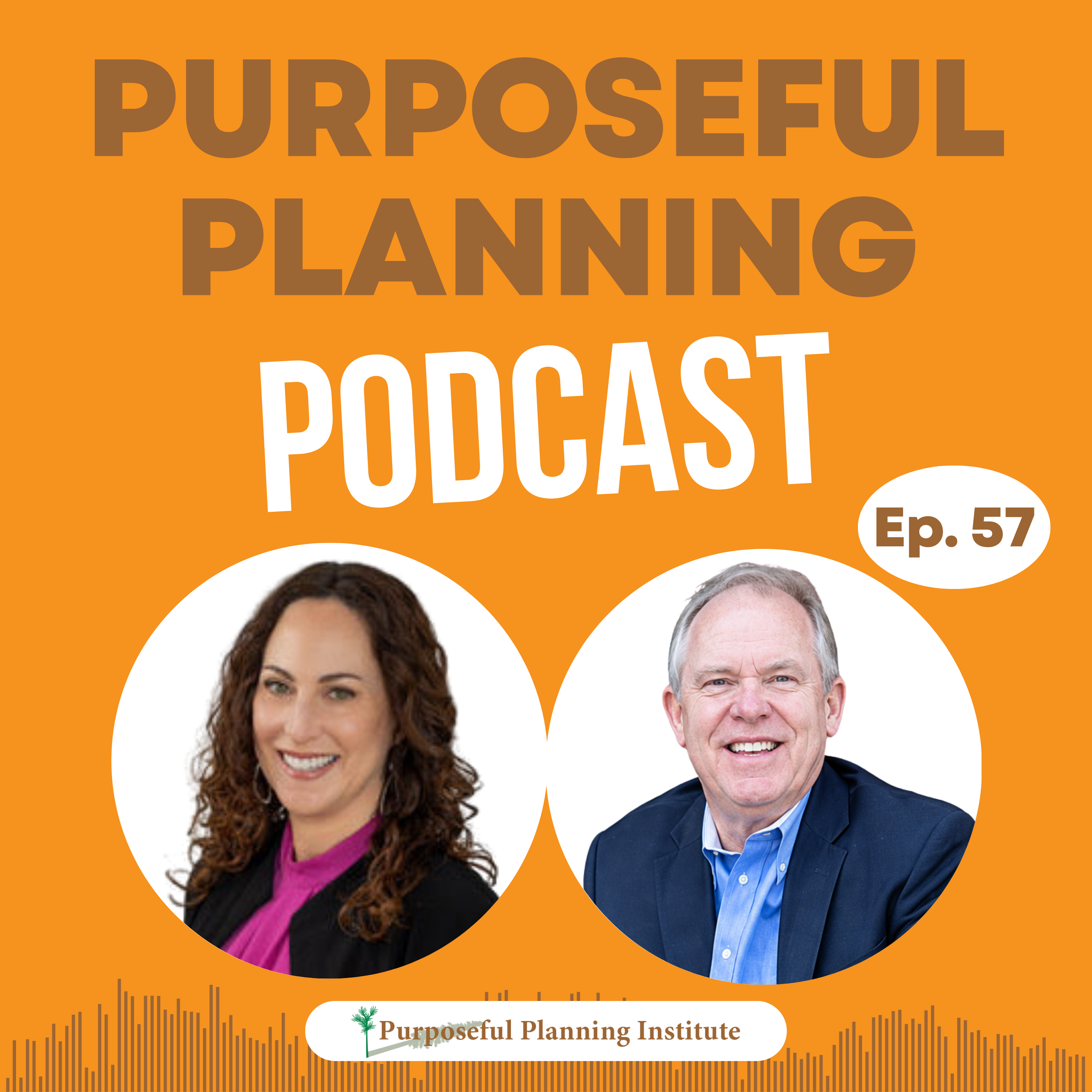
KAREN: Hello and welcome to this episode of the Purposeful Planning Podcast, brought to you by the Purposeful Planning Institute. I'm your host, Karen McNeil, PPI's Dean of Family Stories, History, and Culture, as well as founder of Verdandi and Associates, a family wealth consulting firm specializing in narrative governance. It's my pleasure to welcome award-winning filmmaker Debbie Brodsky, who is the founder and principal of DMB Pictures, and Dave Goetz, co-founder of Journey Sixty6, which captures family and business legacies in books, memoirs, documentaries, and more. After Debbie and Dave introduce themselves, we'll spend a little bit of time talking about legacy projects. But what we really want to focus on today are some of the skills that legacy expert experts use all the time, and which advisors can model to engage more deeply with their clients, so that decisions and outcomes align with values and purpose, and better support well-being across generations. Debbie, why don't you introduce yourself first and tell us a little bit about how and why you got into this space?
DEBBIE: Yeah, thanks so much for having me. It's so nice to be here, having this conversation with both of you. So, yeah, I worked in television for about 15 years, and I was at this point of transition at my time in television where I was kind of wondering, making these wonderful shows, but wondering who was seeing them and what was their reaction. Like, you just didn't get that feedback, and around that same time, I started having these conversations with my husband's grandmother. I lost all my grandparents by the time I was 20, so I got this bonus grandma in in my husband's grandmother, who happened to live nearby, and she was in her early 90s, and she just had all these wonderful stories, and she kept saying, "Oh, you don't need to know those. You don't need to know those." Finally, I got her to sit down with me, and I did like a two-hour interview with her, and put together a short film, and I showed it to my mother-in-law and her sister, and they just learned all these things that they had never known before, and it was such an incredible reaction that I thought maybe this is where I need to be headed, and so I started my company, Damian Pictures, about 20 years ago, helping people tell their family stories for future generations, and it's been a joy.
KAREN: Fantastic! And Dave?
DAVE: So, I have a partner, Melissa Parks, and we have worked together for 28 years together. We worked at a publishing company previously, and then in 2000, I started a consulting firm, marketing consulting firm, and over time, because of our work in publishing, like trade books and professional publishing, they kind of got attached to some of the work we were doing on the consulting side. So, she was working on her PhD at the time when she became and started working. So, she worked with me at the previous organization. Then she came along at the company that I started in 2000, and we got introduced to a family that wanted to do a project called the Legacy Conversation, probably in 2008, and so that kind of started the journey. And then over time, we split off that business from my marketing consulting firm, and then she and I joined up and became partners in the other firm. So, we've been doing this not quite as long as Debbie. Debbie's got a head start on us. I think we're probably 17 or 18 years we've been working in this space.
KAREN: So, it's obvious to us why this work is important, fun, and memorable. But for our listeners, why is this aspect of family wealth management so important?
DEBBIE: Yeah, I think this is, to me, so important. What I found with my clients is that often it's the children, especially the grandchildren, they don't all know their family stories. They don't know, often, their families of wealth, and they don't know where or how the wealth was made. They sometimes just think it happened somehow magically, and so to be able to share those stories with the next generation, to really understand how it all began, the trials and tribulations and challenges, and also the values that came from all of that hard work, and the values that the family carries, the values that they have, even in their philanthropy, has just proven to be so helpful and important to the families that we work with. So, yeah, there's often a disconnect, and it's sort of connecting those dots to make everybody kind of be a little bit more on the same page. Would you say the same for you, David?
DAVE: Yeah, absolutely. I think I'm not sure I can say that any better. I think that's spot on. In the last few years, I've been influenced by a woman named Nora Bateson of the Bateson Institute, and she has a concept called Warm Data. And it's the most delightful thing. Her father actually was a world-renowned scientist, and she's kind of followed in his footsteps. But her thinking is this idea of getting people to talk about these different themes, and something emerges that is new, that doesn't exist before you have those conversations. And so, I think Melissa and I have found in our work that when you have these conversations with family, even though you're thinking about future generations and you want the future generations to have some values and stuff, even in the current moment, just getting families to talk to each other, even if they've heard the story the same way, the same time before, or as many—they hear it in a fresh and new way, and I think it's a way for families actually to come together in kind of really subtle ways. So, I love it for what it does to families in the process.
KAREN: So, it sounds like there's innumerable kinds of applications to family wealth and well-being when these projects are undertaken, and it seems like an obvious thing to do. So, when do families generally undertake these projects? And all families do, right?
DEBBIE: Yeah. Well, they don't all do it. No. They don't. They should.
DAVE: That would be a no.
DEBBIE: They should. I, for me, my clients, what I find, a couple of the themes that are happening often. It's one of the founders, the G1s, it could be, are aging. Unfortunately, they could be getting sick. That's usually not a great time, but that's sometimes a catalyst. So they're aging, and they're showing that these memories are starting to fade, and so they want to make sure they capture them. But it also is this, again, this kind of point of transition when the younger generation is rising up and wanting to have a seat at the table, and this older generation wants to make sure that they understand those stories and that they're carrying through the values. Often, it could be even like an anniversary or milestone, a milestone birthday, an anniversary, something like that that can be a catalyst. Can you think of other ones, Dave?
DAVE: No, that's well said. Maybe we've had, like, the fourth generation want to do it, even while the third generation is in power and is in their probably late 50s and early 60s, and they are now in their early—this fortune is in their early 30s, and they were actually driving it. I don't think the three family members who now run the business actually thought about it, and they were the ones driving it because they realized that there's so much they don't know, and they want the business to persist. It's an amazing business, and the cool thing about that family is they all like each other, and it's three siblings, and it's like, “Wow.” And I remember when Melissa and I met with them for the first time a couple years ago, and they said, "Hey, why don't guys let's go out for dinner?" Well, we had been quite a few family dinners before, and this was just the warmest, engaging conversation. And there were three generations at the table—not three generations. There was generation three and generation four at the table, and there were cousins there, and that's how the project has gone. It has had that same warm engagement. So sometimes it is Gen Four, might be, or Gen Five, maybe a later generation that really feels like they don't want to lose what has already gone past.
DEBBIE: I also was going to add that, like, I think the passing of the torch, like for one of my clients in particular, she was really hesitant to let go of being the head of their family foundation, but she knew it was time. And her biggest thing is, like, she's been carrying on the legacy of her parents and her grandparents and the values. And she felt like her kids were very disconnected from that. And so, for her to feel like she could pass it on, if we had this video that talked all about these legacy organizations they'd been giving to, she felt like it'd be easier to let go, and she didn't let go right away after the film. But she has finally let go, and I think it does help a lot.
KAREN: Yeah, it just mitigates that succession process, and succession defined in lots of different ways, and so both of you have said a number of things that really sparked my thoughts. One is all these ways that advisors can be listening for opportunities for families to engage in projects like these—succession moments, milestone moments. Aging generations, listening to the rising gen who might be in their 30s or 40s or 50s, and you're hearing all of these signals. But I wonder if both of you might talk a little bit more about something that Dave brought up that I think is really invaluable for our whole advising teams to hear a little bit more about, and that's the deep relationships that you have developed with your clients over time, and we talked about this in the past a little bit, the three of us. So it's the deepening of relationships at the same time that you are professionals. So, how are you not crossing that line into an overly emotional relationship?
DAVE: This is a really good question. Thank you, Karen, for that. It's kind of a hard question. One of the great joys of our work is the fact that we get to spend a lot of time with folks, and we don't have an agenda. We're not there for governance. We're not there in therapy. We're not there to really solve a problem or help. We're trying to tease out stories, and so, I don't know if the family's defenses are down. I just know that one of the great joys of the work is these deeper relationships. Let me give an example. So, we're just finishing up a biography of an investment banker who turned around a Chicago investment bank, one of the oldest investment banks in Chicago, that was going bankrupt back in the '60s, and he was part of a large financial services firm. And he did the analysis, and they brought him in. Essentially, I ran the thing along with, I think, two others. But now he's in his mid-90s, and even he was riding his bike because it was raining in Florida, he was riding his bike around in circles in the garage, and he wiped out and broke his hip—you know, at 93, it was horrible—but anyway, this was in the middle of the project. But just the joy of listening to him and hearing his stories, and then going back to him. This project is going to end up being almost two years, and we were worried that he might not survive. So, I think your question of the stories allow us an entrance into people's lives that may be different in kind than maybe other advisors. I don't know that, and I do think one of the things, and I'll end with this, is that we always have to tell ourselves, our whole team that,”You know everything about them.” In fact, one of the investment banker's sons came to me the other day. Said, "You know, there's only two people in this world that know as much about our family as we do, and it's our estate planning attorney and it's you." He said, and that wasn't a threat. He was just kind of an offhand comment, but you do have to set boundaries because they know nothing about you. Nothing. They've never asked a question about you. They're not going to care about your kids, and that's okay. It's not like we come away going, "Man, I wish we could make friends," but they're not friends. But they are deep and trusting relationships.
DEBBIE: Yeah, I think there's something about the trust aspect that's so, so important to what we do. Dave and I have joked before that these clients of ours think that we're very close, that they know us so well, but they actually don't know us at all. But I think because we are just constantly asking them questions and diving in further, that trust builds, and I think that deeper relationships form from that.
DAVE: Well said.
KAREN: It strikes me that advisors, whatever their field is, could benefit from deep conversations like this and deepening relationships. But if they're waiting for a legacy project to come around, then they very well may miss out on learning some of those just little details that make all the difference in finding the right solution for the client, for whatever the task is at hand. So, what kind of recommendations do you have for advisors? What are some of the basic skills that you use or tools that you use with your clients that advisors could use to just open up these conversations a little bit?
DEBBIE: Well, Dave and I have talked about this, and I think for both of us, it's just coming at this with genuine curiosity. I'm just insatiably curious to a fault. Literally, my husband's birthday is tomorrow, and his gift is always, "Can you please not ask me any questions?" No joke. That's the gift that he wants every year, because I'm just always going to ask lots of questions because I'm just very curious. But I think not in a necessarily nosy way, because I just want to know more. I want to know the reason why someone did something. Why? How does this piece connect to that piece? And I was thinking about past clients. I think part of the skill that they could use is sort of thinking about asking those questions that no one maybe has ever asked them before. No one's ever thought to have them reflect on something. I had a client years ago. She probably would be in her 100s now, and I had asked her, “What did you want to be when you grew up?” And she kind of looked at me funny, like, "What do you mean?" She's like, "We basically had a few choices: teacher, secretary, or nurse." She's like, "It never dawned on her to ever think about what else she could be," because it just wasn't a thing then for women to even consider those options, and so no one had ever asked her. And so, she was literally dumbfounded when I asked her this question, and she couldn't really come up with an answer because she had never really thought about it. But I'm sure, had I gone back to her a little bit, maybe she would have thought about it more. But, so, just that kind of thing of opening them up to thinking about things they haven't thought about before. Dave, you have more to add.
DAVE: No, the curiosity thing that you said, Debbie. It's just so spot on. I think for advisors, there's the work itself. If you're in a—there's the family meeting, there's running the family, there's the conflict management, there might be the philanthropy consulting. There's all these different pieces, but I think it's in the white space, and that is where you get to know your clients. It's a conversation before the meeting begins, and it's simply asking them. You have to start out with something that is easy to answer, but then asking that next follow-up question, and just every question that you ask can go down about 90 different rabbit holes, and it's not for prurient interest. But I was thinking just the other day, we're with a family in Ohio, and they invited us after it was a two-part of our two-day work that we were doing with them, and they invited us to their home, and their kids are grown now, and they're not running the business anymore, but the whole executive team now that runs the business, but he showed me what he was passionate. So, during the couple days I was talking with him, trying to find out, like, “What makes this guy really tick?" Trying to understand him, we go to his house or to their house, and he shows me he has these complex Lego sets, and I never saw someone so excited to show me these complex Lego sets. And that is just so foreign to me. I almost didn't know how to ask questions. But my point in this is not the Lego set. The point is, I do think it's in the margins is where you build relationships, deep relationships with clients: before meetings, after meetings, the handwritten note that you do after the meeting, making sure that you know if something, if a surgery is coming up, maybe it's even like I have this 94-year-old that we were just completing this project for. It's taking his call on Saturday afternoon, and he doesn't remember that it's Saturday. I'm like, oof, but it's picking up. So, it's all those little things that I think are outside the actual work that you do that build that deeper relationship.
DEBBIE: I think a couple other things that advisors can think about, one is just that really active listening, really listening—not just to get to the next thing, but listening to what they say and really following up on what they're talking about, and also not being afraid to ask some questions that might be a little tough. That might be a little bit uncomfortable, but you're going to get somewhere. You're going to uncover those things, and then also not be afraid to let it be quiet a little bit. That's a big thing. I know I do this a lot with videos when asking a question. There's that thing that people want to fill the space. They want to fill the silence, and so if I don't fill it, they have to fill it. So, if I'm quiet and there's a tense moment and I just let it sit, inevitably, eventually, more will come out. And so, being patient with that and being okay with being a little uncomfortable can really get some good answers.
KAREN: So, if I can pull a few threads together, I thank you so much for this conversation. So, one, when you said, Debbie, about the woman who's in her 100s now, or 100 now, that she hadn't thought about it. It's a little bit similar to your comment earlier about your bonus grandma. And how nobody would be interested in these stories. And then another thread with, like, the business leader who's been too busy to ponder and to think. So, it's amazing how the floodgates open when somebody simply asks the question, and people do have stories, they have thoughts, they have experiences, they have wisdom, and then they go down their own rabbit holes about, like, the curiosity that emerges from their own comments. So, that was one thing. The Lego set also reminded me of those everyday things. There's a little bit of unlearning that we can do, so that discomfort, Debbie, might be in commenting on somebody's outfit or some aspect of their outfit because we're told we're not supposed to comment on people's hair or whatever it is, and it just reminds me of this one incident where I was actually the customer at the bank, and the person who was helping me was wearing a very distinctive pin on his lapel. And normally, one shouldn't ask about these things, we're told, but I did. I asked him, and it turned out that this pin was made from the 1960s suitcases that his mother used all the time when she was a flight attendant, then called a stewardess for Pan Am, and he clearly had this unbound love for his mother, who had been this amazing source of support and just this love and adoration, and creating that. Imagine being the advisor who creates that moment of joy at the beginning of a conversation for what is going to be a dry meeting. It's just this five-minute moment to be able to have that emotional connection when you ask the question.
DAVE: Yeah. What a great story.
DEBBIE: That is a great story, and it reminds me that I think the most frequent comment I get after the fact is, "Wow, I didn't think it was going to be that fun. That was so much more fun than I thought it would be." Because inevitably, there are several of these folks that don't necessarily want to do this, but they're doing it for their kids, and then they find how wonderful, just joyous it can be to share, and just cathartic in some ways. It's just a really amazing exercise. I had one client years ago. Before, I have a whole process now, but way, way, way back, I didn't have as much of a process, being honest, in the very beginning of my business, and I had a friend whose dad was a Holocaust survivor, and she'd been wanting him to tell his stories, and we had never met. He didn't live in town, and she basically introduced us and she said, "Dad, sit down and talk to her," and then she left and was like, "Oh gosh!” But within a matter of minutes, I mean, he was just opening up and sharing and crying, and it was just a beautiful interaction that we had. And I think it was one of those things. Also, he was hesitant to inevitably tell these stories, but then it was very helpful to him to be able to tell them.
DAVE: Debbie, you said something that triggered a thought. You talked about your process. You didn't have one early on, but now you do. I do think one of the things that some of these projects that we do are like history projects. You're digging in, you're doing research, and you're creating a narrative arc, so it ends up in something, some form of artifact. A family artifact of some sort. But you're not going to get the good stories by sticking a camera in front of Grandma's face and saying, "Tell us about the hard old days," or the good old days. And I do think that, at least in our work, that it's less journalistic and there's layers of stories, and so you'll get someone telling the same story three or four times in the process leading up to your work. For you, Debbie, it's the final interview, but it's all that rich research and work that goes into that that creates the final whatever the family has that is fully layered. They may add in some additional color, the time of day and that nuance, and at least in writing, specificity is what creates interest. There's nothing worse than a general. Nobody reads something that is just general, but it's specificity that makes it really rich. And I think you mentioned that about the process. I think that's really important.
KAREN: Thank you so much. This has been a fabulous conversation. I bet we could go on all day and still only touch the surface of the potential for storytelling and deeper engagement with clients that way. But if you could just leave our listeners with one thing, what would you—what takeaway would you leave them with, Dave and Debbie, whoever wants to go first?
DEBBIE: I was going to share one thing that I think we had maybe discussed in our last conversation, but one thing I would share is just maybe think about asking one question at a quarterly meeting, or one question at some meeting, and getting those wheels turning. Taking notes on the answer, maybe following up the next meeting with another question, and just start introducing this idea of passing on your stories as a way to get people to start getting interested in it, because the saddest thing that happens for me is when people want to do this and then things happen and it doesn't happen. I literally had someone come up to me at Rendezvous and share that she was really sad and sorry that her mother had just passed and we weren't able to tell her story. So, introducing the idea gently, slowly, and over time, that hopefully they'd be interested to do this in some way because it's so important.
DAVE: I think the one thing I would say, which is kind of risky to say this, but resist the tendency to treat the family relationship like a professional transaction, and I've had three businesses, but the one consulting business that I've had for many years, and so a lot of asset management, some investment banking, and wealth management firms we had, and that's just such a different business. And the work that we do with families is very relational. So, and maybe it's seeing the family not as a professional transaction, but, or even a professional relationship, but really aspire to get to know them as human beings, and take the risk, as Debbie said, to ask that question, that curiosity question and that just leads and opens up to so many good things. It takes a little risk and gets to know your family on a different level.
KAREN: I love that. So, build the culture, ask the question, deepen the relationships between the advisor and the client, and ultimately within the family itself. Wonderful. Well, thank you so much, Dave and Debbie. This has been an absolute pleasure for me, and thank you to our listeners. I hope you've enjoyed this conversation, and I'm sure you can reach out to any one of us if you reach out to the Purposeful Planning Institute. I bet they can get you in touch with us if you want to have further conversations about the magic of storytelling and legacy. Thank you.